



How a vision-restoring gene therapy proved that we can treat inherited diseases

Physician and molecular biologist Katherine High remembers sitting at a staff meeting of the gene therapy company Spark Therapeutics on November 15, 2018, waiting to hear from a guest speaker, when the first snow of the season began to fall in Philadelphia. Just outside the auditorium, the speaker, a 10-year-old boy with a rare inherited eye disease called Leber’s congenital amaurosis (LCA), was transfixed by the falling flakes outside the full-length windows. The child, who had previously been legally blind from the progressive condition, was one of the first patients to regain vision from a gene therapy High helped develop. It was the first time he had ever seen snow fall.
“It was very difficult to get him away from watching the snowflakes fall [and] into a room to sit and talk to people,” High, who co-founded Spark Therapeutics, recalls. Witnessing the child marvel at the snowy scene was “obviously very profound. It was breathtaking.”
High, molecular biologist Jean Bennett and ophthalmic surgeon Albert Maguire are three of the key players who developed Luxturna, a gene-augmenting therapy that can help reverse some inherited retinal diseases, including a type of LCA. LCA affects thousands of people globally and is responsible for 20 percent of childhood blindness. People with LCA are born with very poor vision, which slowly worsens over time—this is caused by a faulty chemical mechanism in retinal light-sensitive cells.
On supporting science journalism
If you’re enjoying this article, consider supporting our award-winning journalism by subscribing. By purchasing a subscription you are helping to ensure the future of impactful stories about the discoveries and ideas shaping our world today.
“Whatever poor vision they have as infants disappears because the cells die off progressively as people grow,” Bennett says. “By the time they’re 20, they’re usually stone-cold blind.”
By targeting a gene central to the molecular dysfunction and creating a novel system to deliver functional genetic instructions, High, Bennett and Maguire were able to move their therapy from the lab to experiments in dogs and finally to clinical trials in humans. They demonstrated in patients that the technique could resuscitate retinal cells and increase visual sensitivity more than 40,000-fold.
“For young patients, we’ve had people who have had their visual field restored to what would be considered normal,” Maguire says.
The U.S. Food and Drug Administration approved Luxturna to treat LCA in 2017. The one-time therapy—which costs about $425,000 per eye—is injected under the retinas. Since the first trials, at least 500 people in the U.S. have received the treatment.

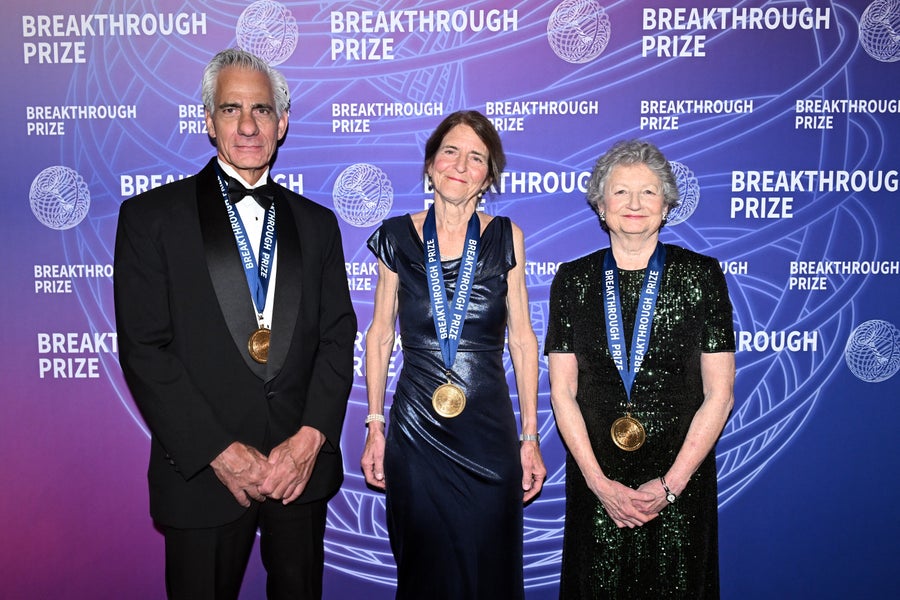
(L-R) Albert Maguire, Jean Bennett and Katherine A. High, who each won the 2026 Breakthrough Prize in Life Sciences at the Breakthrough Prize Ceremony on April 18, 2026 in Santa Monica, California.
Getty Images for Breakthrough Prize
The trio recently won a 2026 Breakthrough Prize for this work. Scientific American spoke with Bennett, Maguire and High about the challenges of developing the therapy and conducting human trials, the ways they gained trust with patient communities and the future of the research.
[An edited transcript of the interview follows.]
What is Leber’s congenital amaurosis? What are the symptoms?
MAGUIRE: Leber’s congenital amaurosis is a retinal disease that affects photoreceptors [light-sensitive cells]. It is a progressive degeneration because of genetic biochemical defects which result in blindness.
There are numerous genetic subtypes of Leber’s congenital amaurosis, and early on, they look different in terms of severity. For instance, type LCA5 is an early onset severe visual disability characterized by oculodigital behavior, in which people press on their eyes to stimulate mechanical light. From birth, they really do not have very useful, functional vision. They can’t read. They have no night vision. That’s a very severe form, which is still being worked on.
LCA2 [which Luxturna is approved to treat] is a type that’s a little less severe. People with LCA2 haveabnormal, jiggling eye movements soon after birth because they can’t see things sharply enough to fix their eye on them. They usually have very poor sensorial acuity [inability to see details or objects from backgrounds]. They have nystagmus, which is when their eyes are moving around, sort of sweeping the area to pick up on things. They tend not to look at faces, and that’s a kind of peculiar visual behavior from birth, which is usually what triggers parents to get an evaluation.
At very low illuminance [or light] levels, they have no vision at all. They have basically one ten-thousandth the sensitivity to light that you or I have—sometimes even less than that. If you could imagine covering all the lights in your room and just putting a few pinpricks through cardboard to let a little light through, that’s about what they’re seeing. That’s their normal. They can get around reasonably well in high ambient lighting, but they go from legally blind to just blind over two decades or so.
How did you find out the RPE65 enzyme was so important in the root of the disease and the effectiveness in the therapy?
BENNETT: Michael Redmond at the National Eye Institute at the National Institutes of Health had characterized an enzyme encoded by the gene RPE65. This enzyme cleaves the ester bonds in the neuronal portion of the back retina—the retinal pigment epithelium— to create a usable form of vitamin A, a molecule called 11-cis-retinal. This goes to the photoreceptors. When 11-cis-retinal absorbs light, it converts into 11-trans-retinal, which starts the process that converts light into electrical signals and is important in sight. The trans form goes back to the retinal pigment epithelium, where the enzyme acts on it again to convert it back to usable 11-cis-retinal. So there’s a cycle of retinal molecules that goes between photoreceptors and the retinal pigment epithelium.
LCA is caused by the lack of this RPE65 enzyme. The exhausted 11-trans-retinal form doesn’t get converted back into a usable form and instead accumulates and distorts the photoreceptors; it’s basically like garbage in the cells. To us, this was perfect: The enzyme is not working. Let’s deliver the normal copy of the enzyme and cure that blockade.
How did you do that?
BENNETT: We created a vector [a biological delivery mechanism] with the adeno-associated virus (AVV). We know most people have been infected with it because we can detect antibodies in the blood showing exposure. It’s usually coinfected with the common cold in childhood, and it very rarely has been shown to cause disease in humans or animals. It’s essentially a harmless virus. The form we use is neutered—it doesn’t have any genes to allow it to replicate. We basically pack it with a type of synthetic DNA that encodes for the missing gene, RPE65, and a promotor, which acts as an “on” switch for gene activity. So the virus carries the gene into the cell, where the gene travels to the nucleus and sets up shop and ultimately starts making the RNA and protein, etcetera. But you can’t just apply this to the eye and hope that the gene will get to the cells in the back of the retina. That’s where the surgery comes in.
MAGUIRE: The trick is going into the eye to the retina which lines the back [of the eye], like an inner tube, and injecting the material [vector] between the photoreceptor nerve cells and the retinal pigment epithelium cells, which lie underneath. You create a little balloon of the mixture holding the virus vector, which is absorbed by the retina.
We did this in mice with extremely small cannulas or pipettes. In larger animals, I adapted available tools that had been developed for human surgery for the dog eye, which is pretty similar in size and anatomy to human eyes. The dogs [which carried the same genetic defect for LCA as humans] had the funny eye movements. They will be very timid in crowds and they jump at noises. After surgery, they could navigate through obstacle courses. They socialized with other animals. We found that they were so good with their vision, they would steal kibble from the untreated littermates.
“Seeing and hearing the desperation of people who are going blind, that’s where I just feel as a doctor a commitment to working on conditions like that.” —Albert Maguire, ophthalmic surgeon
What were some of the major outcomes of the clinical trials?
HIGH: There were several challenges for the phase 3 trial, which began in 2012, but most prominently was what were we going to use as the controls and what would we use as the primary endpoint [or efficacy measurement]. At that time there was no treatment for any inherited retinal dystrophy, so there was no agreement on what the primary endpoint should be. The FDA held an advisory committee meeting where they invited eight experts in inherited retinal dystrophies to discuss the primary endpoint. And as you may imagine, with eight experts, we got 10 different viewpoints. So we took notes. The FDA took notes.
We wanted it to be something that even young children can do. It needed to be a visually dependent activity of daily living. So we eventually decided on a mobility test. We had more than 4,000 videotapes of people doing this mobility test we developed, and therefore we had very robust statistics on its performance characteristics. And I think that helped convince the regulators that it was something they could trust and bank on. I’m very proud of the fact that we were able to develop this novel clinical endpoint. And I think that if we’re going to be successful in gene therapy for genetic disease, we will need to do that over and over again.
How does the therapy work?
HIGH: Once the patient meets all the eligibility criteria and we have all their baseline data, they go into the operating room, go under general anesthesia, and we do the injections. The procedure takes about 45 minutes. You do one eye, and then you wait about a week, and then you do the other eye. It is important for the patient to lie on their back for about 24 hours after the procedure. If the doctor is concerned that a patient, such as a child, will not be able to do that, they may keep them in the hospital, but otherwise this is an outpatient procedure. After that, the vector is pretty much absorbed into the tissue. And then people come back to the clinic for regular visits to check progress.
Typically at about 30 days, people will notice a difference. During an initial trial, a woman who was about 28 years old called her ophthalmologist a few weeks after the surgery and said, “I woke up this morning and I could see the furniture in the apartment.” She was used to getting around without visual cues, and now she could actually see the furniture in her apartment. I didn’t know what to make of one person saying that. You always want to maintain some skepticism. But when it became a consistent report, then I was pretty excited.
“This work has gone other places. There are more than 140 different retinal gene therapy clinical trials that have been approved to start.” —Jean Bennett, molecular biologist
What has it been like for you to work with this patient community?
BENNETT: The patients are the real pioneers—volunteering their time and efforts. The first patients who enrolled in our studies in 2007 [were] coming back for their last visit [in April]. This is 15 years after their second eye was treated. We’ve seen them get married, raise their families and have careers and have gotten to know them very well.
MAGUIRE: When we started, the word “incurable” was thrown around a lot. These inherited retinal degenerations had no treatment. People with these conditions have occupational therapy and supportive interventions, but they had no medical treatment. Seeing and hearing the desperation of people who are going blind, that’s where I just feel as a doctor a commitment to working on conditions like that.
What’s in store for the future of this work?
BENNETT: This work has gone other places. There are more than 140 different retinal gene therapy clinical trials that have been approved to start, and many of those trials are in late phases. The research is now approaching treatment for very common diseases, such as age-related macular degeneration. There are some early trials with glaucoma and diabetic retinopathy.
We’re also now seeing gene therapy being applied to other organ systems. There are some recent results showing some dramatic improvements in hearing in children born deaf. I’m really excited about that because a medical student in my lab did the first studies showing that it’s possible to deliver genes to the cochlea and reverse some forms of deafness. There are systemic diseases which are now being addressed, such as Duchenne muscular dystrophy, and there are approvals now for [gene therapies for] spinal muscular atrophy and some forms of hemophilia. It’s so wonderful to see gene therapy working in a number of these diseases.


