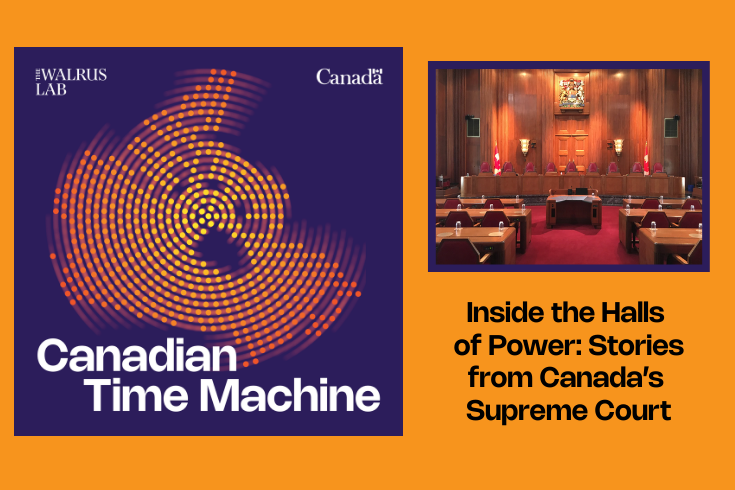
Founded in 1875, the Supreme Court of Canada has shaped the country for 150 years—yet the stories behind its decisions, its building, and the people who have walked its halls often remain out of view. To mark this milestone, Canadian Time Machine goes beyond the headlines and into the quieter, more surprising corners of Canada’s highest court.
Host, Angela Misri, sits down with filmmaker and lawyer Étienne Trépanier, whose new project reimagines how Canadians might experience the Court at a moment of major change. Then, former Chief Justice Beverley McLachlin reflects on the institution she helped guide for nearly two decades, offering rare insight into what makes the Supreme Court both uniquely Canadian and profoundly human.
Listen to the episode:
Angela Misri: This year marks the 150th anniversary of the Supreme Court of Canada, a milestone that invites us to step back and reflect on the court’s role in shaping our country. For most Canadians, the Supreme Court is a distant, formal place where weighty decisions are made that touch our lives in ways we may never see firsthand.
Angela Misri: Welcome to Canadian Time Machine, a podcast that explores key milestones in our country’s history. I’m Angela Misri.
Founded in 1875, the Supreme Court of Canada has served as the highest court in the country, interpreting laws and the Constitution and shaping the legal framework that governs everyday life. Over 150 years, it has been at the center of landmark rulings from individual rights and freedoms to indigenous land claims. Its decisions reflect the evolving values and diversity of Canadian society. And I had to teach a law and ethics class this semester, and I read so much about all the landmark decisions this summer, I feel like I got the grade eight, like full time download into my brain, and it was fantastic, but there is so much to cover. So in this episode, we’ll explore the Supreme Court’s legacy and hear how its stories are being shared in new ways, and later, we’ll meet Canada’s longest serving Chief Justice, the right honorable Beverly McLaughlin, and learn what it was like for her to help make decisions that shaped the nation. But first, let’s meet someone who banded together a motley crew of Canadian creators this year to bring the Supreme Court’s halls and history to life.
Étienne Trépanier: So my name is Étienne Trépanier. I’m a lawyer slash filmmaker slash producer. I’m now based at the University of Ottawa, but I was a practicing lawyer for 25 years at the Department of Justice.
Angela Misri: In 2020 during the early days of the pandemic, Etienne pitched the idea that would become juravision.ca based at the University of Ottawa’s Faculty of Law. It’s an audio visual platform that uses video interactive content and even gaming to make legal knowledge more accessible. Instead of wading through dense court documents, Canadians can now engage with the law in ways that are clear, practical and even a little fun. I wish I’d had that this summer.
Étienne Trépanier: I started to work with professors who have great knowledge, great ideas, but sometimes cannot implement them, you know, because they don’t have either the technical skills or the time or even their financial resources, so I kind of acted as a vector a producer, basically to help them connect their ideas with creators who have the skills, you know. So the in Canada, we have a fantastic and a very rich community of creators and video and audio and gaming. So how can we take that knowledge in the university and in the legal practice, and make it available in new formats.
Angela Misri: With a deep ongoing connection to the Supreme Court. The University of Ottawa is uniquely able to bring projects like this to life. It’s got access that other universities could only dream of.
Étienne Trépanier: Because our faculty here at the University of Ottawa, first, as in Ottawa, has very good relationship with the judges. You know that every time there’s a new judge named at the court, there’s an event here at the faculty Ola where we welcome that new judge. So it’s a tradition. It’s been ongoing for years.
Angela Misri: So as the 150th anniversary of the Supreme Court inched closer, it just felt natural for the University of Ottawa to collaborate with the court on some sort of legacy project.
Étienne Trépanier: It’s a true Canadian project, because we had, we had a team from from Quebec, from Ontario, we had the original music. It’s an indigenous company that did their from when they came back, who did all the graphic design, our filmmaker Julie corbeil, and a team of those who did, also all the marketing, are based in Toronto. So it was a massive team, you know, for me, it’s probably the biggest, you know, project I’ve worked on.
Angela Misri: And thus, the Supreme Court experience was born. It has two key components. The first, an interactive Docu course called Keys to the court. The second, an immersive video game called Echoes of the court.
Étienne Trépanier: You’re a janitor at night, there’s nobody in the building, and you have some tasks, some normal janitor, you have to clean, empty garbages, but you’re also a writer. At the beginning of the game, the Chief Justice tells you, “Oh…
Excerpt: “… I just found out that in your spare time, you’re writing a novel inspired by the stories of those who have passed through this court. I think that’s a remarkable idea. I’m certain you’ll find inspiration on your night shifts. If you listen closely, if you pay attention, you will notice that the walls speak. They carry the echoes of those who have passed through the court.”
Angela Misri: The game is played in a first person perspective. So you start off standing in the Supreme Court’s grand entrance hall. You’re alone, and it’s quiet, and if you look out the window, you can tell it’s late on a snowy night, the only sounds are your footsteps and the game’s original music, a gentle, wandering piano piece that changes tone as you move through the building. You’ve got the Supreme Court of Canada to yourself, and you walk, jump, look around and interact with hidden objects like pamphlets, letters and photos as you explore every night.
Étienne Trépanier: There are some little pieces that you can find that are hidden. Coasters, for example, coasters at the Supreme Court. When we did the digital scanning of the court, the technical team that was with us were very impressed by all those coasters in the room and everything, so we decided to create a digital version and hide it in different places.
Angela Misri: In fact, every detail throughout the game was digitally scanned from the real thing, making it as accurate as your phone screen can possibly depict.
Étienne Trépanier: You can even find the loonie. The Canadian Mint has released a new loonie, especially for the Supreme Court 100 and 50th anniversary. So there are digital version hidden there and there.
Angela Misri: And as you discover new objects and move through the cork, mop the salt stains off the floor and slowly write your novel, you truly do hear echoes of the court.
Excerpt 1: It came down to whether I wanted to go to the Supreme Court. If I said no, I didn’t want to go to the Supreme Court, then we weren’t going to the Supreme Court.
Excerpt 2: There will be some challenges when we will be fighting this case is there will be constant media around you, there will be questions, there will be a lot of things. There will be financial issues.
Excerpt 3: Keeping in mind this would have been 1970 so that realization that we lost by one vote, it was really difficult, because I had that sense of loss and belief in justice, that was what I felt.
Angela Misri: These are the actual voices of the judges, lawyers and Canadian citizens who worked on these groundbreaking cases.
Étienne Trépanier: Our first objective was to get people to live, you know, the human aspect of going through the court a person that gets into echoes of the court will will live the human experience of the court. So the lawyers who stressed before the hearing, the judge who’s asking himself, you know, should I ask the question or not? The person who lost and felt that, you know, that Justice wasn’t rendered, maybe.
Angela Misri: Etienne estimates that in total, it took around 40 people to build the Supreme Court experience, and that includes the Docu course and the game, and what seems like a very ambitious, multi faceted project actually came together rather smoothly.
Étienne Trépanier: And from a production perspective, I knew that at one point those two would meet somehow. I didn’t know exactly how, but I knew they would meet, and they did effectively meet, because when you look at the game, or portions of the games that are drawn from some of the interviews we did for the Docu course, and when you look at the Docu course, there are some graphic designs in the Docu course and some elements that are drawn from the game. So it was a very good decision in hindsight.
Angela Misri: The Docu course, Keys to the Court, also gives you a different perspective on some of Canada’s most famous court cases than you might be used to hearing.
Étienne Trépanier: It was very important for us not to get just a perspective of judges and lawyers, but we went and met five Canadians from coast to coast who have lived the Supreme Court.
Angela Misri: Among the stories are a woman reclaiming her indigenous status, a man turning a personal injury into a fight for disabled rights, and a francophone parent in BC battling for equal school facilities for her children. And between the course and the game, the Supreme Court experience is about to be the only way you can experience the building itself as it currently stands.
Étienne Trépanier 9:22
You can discover the very rich environment of that national treasure, really. That is this building that was designed by architect Mr. Cormier, architect under Mackenzie King at the time in the 30s and 40s. So it’s an incredible building. We should be all proud of it. It will have to close for the next 10 years because of they have to do extensive renovation, like they are doing right now for Parliament Hill, or our game will be the only way you’ll be able to visit this building for the next 10 years.
Angela Misri: Since the Supreme Court experience went live this October, it has already drawn 1000s of visitors, hundreds of downloads and plenty. Early buzz on social media, but Etienne says the most surprising feedback has been from other educators.
Étienne Trépanier: Law professors or law teachers at high schools, reaching out to us, saying, I want to work with you and your team to adapt that content to use it in my classroom. Whenever the professor was telling us that the most recent tool she had to teach the Supreme Court was an old, 20 year old CPAC documentary, so she was very excited that this tool had been developed. So we’re really much entering in what I call phase two now of the project, which is try to get our funders and partners to take that content and find ways to adapt it, either through guides or workshops for that specific audience of students in high schools.
Angela Misri: In many ways, the mission behind the Supreme Court experience is similar to what we do here on Canadian Time Machine, taking complex stories, unpacking them, and making them engaging and accessible for audiences across the country.
Étienne Trépanier: So it’s our job as creators and educators and universities, I think, to bind together and create content that’s engaging. So it’s a mission that we have to carry and find original ways to reach that audience with relevant, smart I call it knowledge based content. You know, knowledge based content, but engaging content at the same time. So, so So that’s what we’ve tried to achieve. So I hope, I hope folks, people enjoy it.
Angela Misri: Etienne’s work brings together law, history and storytelling in a way that invites all of us to step inside the Supreme Court virtually, at least for a closer look. Up next we hear from someone who’s walked those halls for real. Canada’s longest serving Chief Justice Beverley McLachlin, she’ll share what it was like to make decisions that shaped Canadian law and stories from behind the bench. Chief Justice McLachlin, thank you so much for joining us. Thank you. It’s wonderful to be here. So you’ve said before that the Supreme Court has its own distinctly Canadian character. From your vantage point as Chief Justice. What do you think truly sets our court apart, both at home and internationally?
Chief Justice Beverley McLachlin: Well, our court has a distinctive character because it reflects the distinct nature of our legal culture and our country. The basic legal traditions that we inherited were inherited from England in the early period of the country, until 1950 the Judicial Committee of the Privy Council was indeed the final court of appeal. Now there’s a distinction. You had a Supreme Court in place from 1875 but it wasn’t the final court. Now, like most countries, the Supreme Court is the final court. So that distinction has gone another thing that makes us so distinct is the adoption of the Charter of Rights and Freedoms in 1982 which really is a unique document, and I think a document, it has its tractors, but it is widely admired around the world, and people admire Canada for having done that and our court for having interpreted it in in a robust way that really gave effect to the rights and freedoms. And right now, we’re seeing a debate about another distinction in order to get the charter through the government, Pierre Elliot Trudeau and his minions agreed that they would include a notwithstanding clause in Section 33 and for many years, this didn’t have much impact, but now we’re seeing that come. So people look at Canada, they say, Oh, what is that? An outwithstanding clause, and that makes us unique. So in many, ways, we have developed a very unique jurisprudence and a unique court system.
Angela Misri: Yeah, I mean the notwithstanding clause as a journalist, that has come up so much in the last like 20 years of reporting that we didn’t really talk about beforehand. So yes, in distinct, I don’t know of good distinct, but definitely distinct that we have it right now. So over your years on the court, how did you see it evolve to reflect the diversity of perspectives across Canada? Or did you see it? I don’t want to make a leading question, did you see it evolve?
Chief Justice Beverley McLachlin: Oh yes, hugely. When I started practicing law back in the early 70s, the law was men, if you looked at the courts, elderly men, they were almost all white skinned, Caucasian of some sort or another. So it was a very, very thin slice of society, if you wish. And even the lawyers who were practicing, there were very few women and legislators who were in there were not that many. So it wasn’t a diverse system at all. We really hadn’t given full recognition to indigenous history and rights. We didn’t even have a language to talk about them, and we hadn’t our society, although it was beginning. To reflect immigration from many parts of the world. It was just beginning, and for the most part, it was just white, Caucasian, etc, and people of color, indigenous people, others from different backgrounds that were not mainstream. I think, saw the law as an alien thing and the courts as an alien thing, that this didn’t reflect them, and they were very, very concerned about getting involved with that. And when they did get involved, it seemed to be, it was always in a negative way, being charged with some crime or having done something wrong or etc. Now that it has completely changed, about the mid 70s, we saw a lot of women coming into law. They gradually got more women on the bench. And that continued. There has been a real push for ethnic diversity on our courts, indigenous representation on our courts, and there is general acceptance of the value of having a legal system and a court system that looks like reflects the population it is serving.
Angela Misri: I mean 18 years walking the halls of the Supreme Court, the longest of any Chief Justice, beyond the big cases, which I’m sure stand out in your mind, is there a moment or a memory that captures what it actually felt like to serve in that role, day to day?
Chief Justice Beverley McLachlin: Oh, it’s so hard to find moments, because there were so many. And I was a Supreme Court judge for nine years, and then I was 18 years almost on as a chief justice. And there were many, many moments, some taught me humility, and others that made me very proud. The humility part came when as Chief Justice, one has responsibility, one thinks for the general operation of the court, and one wonders how one is going to discharge that. Four days after I was named Chief Justice, I got a call from a friend who was had been a state chief justice in California, and he said to me, after saying congratulations and all the nice things, he said, Well, don’t get too excited. They hand you the reins of power, but it takes about two days to discover they aren’t connected to anything. And he was absolutely right. It requires a very special kind of leadership, leadership by example, leadership by subtle direction, if you can even call it direction, but mainly leadership by just encouraging everybody to be their best, and that’s what I resolved I could do. I didn’t have any power to hire or fire or promote or not promote. And each judge, as you know, is entirely independent. And so it doesn’t operate like the usual corporate model. And you have to exercise your leadership in a collegial way, bringing everybody in, trying to encourage people to work together. That can be awfully hard, and it it can be hard for everybody involved, because often it’s easier just to go off and write your own judgment, for example, and and then that’s done. I can move on. But if you’re in this collegial situation, you are having to listen to your colleagues in a real way of listening, taking on what they’re saying, and then try to digest it and see whether that all modifies your view. Bert will Bertha Wilson, the first female judge on the Court, said to me, I was when I asked her, shortly after being sworn in, as to her philosophy on the judging, and she said, Well, I think that the people of Canada are not entitled to just nine views of nine judges on each question. They are entitled to the views of each justice after that justice has listened to and considered the views of all his or her colleagues, and that was very profound and very true, and I tried to adopt that in my time as Chief Justice and highlight moments, I mean, there were many, maybe not a single standout highlight that I can remember, but during my time, great developments in indigenous law that gave me great joy to see our first people finally having their rights recognized, and the Court suggested in early decisions that we were all here to stay and we had to find a path of reconciliation. So to see governments and society generally in Canada taking up this project of reconciliation with grace and joy and for the most part, very generous understandings, has been a real highlight of my career. Also, advances in gender equality have been absolutely stellar, and there are many cases where we were. Able to advance those kind of rights and get closer to a society that is truly equal for everyone
Angela Misri: You’ve described judging as an active imagination, putting yourself fully into the shoes of the people in front of you. How does that approach help illuminate the importance of something like the Oaks test and the balance it tries to strike between individual rights and society’s needs.
Chief Justice Beverley McLachlin: When I started thinking about judging as an act of imagination, I thought about it as a trial judge would think about it you have two people, or you could have more, but for simplicity’s sake, we’ll have two protagonists before you, or you have the crown and somebody who’s been accused of a crime, and they have completely different views of how this case should come out, and they often tell different stories, and they have different arguments about how the law should apply. And I felt my job as a judge was to make sure I understood each of those protagonists as well as I could, and I did that by what I called an act of imagination, which is almost like an actor deciding to put herself into The skin of a character that that actor is playing, what would it be like to be in that person’s shoes? And that takes imagination, because you know you are who you are. As a judge, come from a certain strata in society, a certain milieu, and it helped me a lot to try to put myself in the position of the parties I was dealing with, and I felt that my judging became fairer, because even if one person had been accused of some heinous crime, I had to try to think about how it was for them, what the system owed them, and why they might have done what they did, to better understand that, particularly in sentencing. So this is how I developed this idea of actually, in a deliberate way, trying to think about a case from both perspectives. And I found often judges, if there was a problem in judging, it was that often judges had a certain perspective that came from who they were and where they are, and they decided very early on in the case, this person is lying, this is the way the law should go. This is why it doesn’t. And they that kind of block the further exploration of the rightness and wrongness of what was happening. And so I wanted to be an exploring judge, and I found that was a tool. Now you asked about how that would apply abstractly to a legal principle or legal charter issue. Under the Oakes test, which is, you have a potential infringement of a right, but the government or the state party has the right to argue and bring evidence that the benefits of This impingement on rights exceed the importance of the whole upholding the rights. So it’s kind of a balancing test. And there too, I think one does do this high level analysis. You have to think about the importance of the government objectives, the goal. You have to think about what the government is trying to do. You have to ask whether it goes too far? Because often under the oak steps, it goes too far. How do you do that? Well, you have to understand the problem as well as you can. And on the other side, you have to understand what upholding this right means to the individual or group in question. And so it’s the same kind of mechanism trying to really understand both points of view.
Angela Misri: Another landmark decision was delgamuk versus British Columbia in 1997 which became foundational for indigenous land rights. Given your early exposure to indigenous communities in Alberta and your long view of the law, what do you think that decision changed in Canadian law and in Canadian society.
Chief Justice Beverley McLachlin: Well, it was one of the first important decisions. There were a number of them, but Delvin MOOC was really dealing with whether the Canadian law had to recognize indigenous practices and entitlements and accord them some sort of priority, and if so, what it also was concerned with the issue of what we call historical oral evidence, the situation that the indigenous peoples found themselves in is that their way of keeping records was not this way of European societies. So they didn’t have deeds of title. They didn’t have letters saying you own this, or this is your practice, or you are always entitled to fish in these waters, and your ancestors have done it because we have the fishing permits here. They couldn’t present that kind of evidence, and the way they kept their evidence was that it would be passed down from generation to generation through particular people who were chosen as the bearers of witness and the carriers forward of the past. They knew the whole past of what their people had done, and this was their way of every generation maintaining their history and their culture. So the one of the issues in delgamuk was whether the courts could admit oral evidence. Now, generally, under the rules of evidence, you cannot admit oral evidence on previous things that the speaker herself or himself did not see or witness. It’s called hearsay. So this was hearsay in a very major way, and the first courts in British Columbia Trial and Appeal said no, we can’t have I think on the appeal, they did modify it, but the trial certainly said no, we can’t let this evidence in. It wouldn’t be reliable, and so on. And had that ruling persisted, I think it would have been pretty difficult, if not impossible, for indigenous people to ever prove any claims because they just didn’t have the written documents that would be relied on ordinarily. And the Supreme Court of Canada affirmed that, yes, this evidence was admissible, provided there were guarantees of reliability, the person in question would have to show that they had been called a knowledge keeper, or whatever the relevant term in their culture was and describe the traditions, and then they would have to give precise evidence as to what those ancestors did in delgamuk. We were concerned with fishing rights in the Lower Mainland of British Columbia and cultural practices. So these were things that they testified to, that evidence was accepted. Now one who also, I think, and I alluded to this earlier, has the seeds of the contemporary idea of reconciliation between first peoples and those who came after. In the end, the Chief Justice le mayor said in His judgment, let’s face it, we’re all here to stay. It was an invitation to get along, to move forward in a spirit of justice and cooperation and reconciliation, which has since then happened as the
Angela Misri: Court marks its 150th anniversary, and as someone who helped shape its modern era, what do you hope Canadians understand about the Supreme Court’s role in our country’s story and where it’s headed next?
Chief Justice Beverley McLachlin: Oh, that’s two questions, but not 100. My, well, the role of the court is to decide the thorny legal issues that arise in our country from time to time. These could be anything from issues of criminal law, issues of commercial law to major issues of constitutional law or indigenous rights, and sometimes even touching on international we have three branches of government, Parliament or the legislatures, executive, which is the prime minister, cabinet and all the way down, all the people who enforce the law, and we have the judicial and the role of the judicial is to be there when questions arise, and particularly in a society that recognizes rights and freedoms as ours, when have rights been violated? What is the extent of freedoms in certain areas? Now this can’t be done by Parliament, traditionally, in our system, or the legislatures, although they may think they want to do it, it can’t be done by the executive to have credibility. It has to be done by an independent body. And the Supreme Court of Canada is the apex court of a system of courts that are all independent, apolitical. I’m very happy to stress that the court is apolitical. It doesn’t belong to any party, and it doesn’t adhere to any parties. And look at these issues that the citizens bring or the governments bring to the court and decide them, and that’s its role, in a fair and impartial manner, in a manner that is apolitical. Now you asked, where is the future? Well, I hope the future is much of the same. We see some erosion, as I speak of the principle of judicial independence, of respect for the courts, not in Canada, but south of the border and in other countries as well, to some extent, we have to recognize that our rights and freedoms are precious, our constitution is precious, and we need to maintain the independence of our judiciary, and we need to maintain the role of our judiciary. Temporary in regulating these questions. That is why, in some of the arguments coming up in the Supreme Court on the notwithstanding clause, people are saying, yes, it’s there, but you can’t just kick out the judicial you have to have a judicial review first. I don’t know what the court will decide on that issue, but what they’re saying is get we have the notwithstanding clause, but we need to preserve a role for this impartial adjudication within that system, so we can protect the rights of people to the maximum amount if, in the end, they have to be overridden, fine, but we need to preserve the judicial role to the extent that we can.
Angela Misri: Thank you so much for joining us, Chief Justice McLachlin.
Chief Justice Beverley McLachlin: Thank you. Thank you.
Angela Misri: Thank you for listening to Canadian Time Machine. This podcast receives funding from the Government of Canada and is created by the walrus lab. This episode was produced by Jasmine Rach and edited by Nathara Imenes. Amanda Cupido is the executive producer for more stories about historic Canadian milestones and the English and French transcripts of this episode. Visit the walrus.ca/canadianheritage. There’s also a French counterpart to this podcast called Voyages dans l’histoire canadienne. So if you’re bilingual and you want to listen to more, you can find that wherever you get your podcasts.


