Plasmid construction
Plasmids encoding Lb, As, Er and other Cas12a variants, as well as BrCas12b, were constructed following previously described protocols22,24,44,45,46,47. Escherichia coli codon-optimized Cas12i1 and Cas12i2 plasmids were obtained from Addgene (Arbor Biotechnologies, 120882 and 120883). For mammalian expression, the NLS was removed from AsCas12a-P2A-GFP (Addgene, 160140) by KLD mutagenesis. The mCherry construct was generated by inserting the coding sequence into a pCMV vector lacking the CMV enhancer. RfxCas13d, PspCas13b (derived from Addgene, 155367) and DisCas7-11 (Addgene, 172507) were cloned into a common backbone.
For lentiviral expression, AsCas12a-P2A-GFP was subcloned into the lentiCas9-Blast vector (Addgene, 52962) using NEBuilder HiFi DNA assembly (New England Biolabs (NEB), E2621L). RNase H1 was amplified from ppyCAG-RNase H1-WT (Addgene, 111906) and fused to the N terminus of AsCas12a, whereas METTL3 together with NLS was amplified from pCMV-dCas13-M3nls (Addgene, 155366) and fused to the C terminus.
Protein expression and purification
Rosetta (DE3) cells harboring expression plasmids were grown on agar plates at 37 °C overnight. Single colonies were inoculated into 10 ml of Luria–Bertani medium and cultured for ~12 h, followed by expansion into 1.5 L of Terrific Broth medium. Cells were grown to an optical density at 600 nm of 0.6–0.8, cooled for 45–60 min, induced with 0.5 mM IPTG and expressed at 16 °C for 14–18 h.
Cells were harvested by centrifugation and resuspended in lysis buffer (500 mM NaCl, 50 mM Tris-HCl pH 7.5, 20 mM imidazole, 0.5 mM TCEP, 1 mM PMSF, lysozyme and DNase I). Lysates were clarified by sonication and high-speed centrifugation, filtered (0.22 µm) and loaded onto a HisTrap FF column (Co2+-charged) using a fast protein liquid chromatography system. Proteins were eluted with imidazole-containing buffer (250 mM imidazole).
Except for Cas12i1 and Cas12i2, fractions were pooled, treated with TEV protease and dialyzed overnight at 4 °C in buffer (500 mM NaCl, 50 mM HEPES pH 7, 5 mM MgCl2 and 2 mM DTT). Samples were concentrated and further purified by heparin affinity chromatography followed by size-exclusion chromatography (Superdex 200). Peak fractions were pooled, concentrated, flash-frozen in liquid nitrogen and stored at −80 °C.
Oligonucleotide preparation
All ssDNA and RNA oligos including guide RNA, guide DNA, target activators, primers and fluorescent reporters were obtained from Integrated DNA Technologies (IDT) and diluted in 1× TE buffer (10 mM Tris and 0.1 mM EDTA, pH 7.5). For generating long RNA target mimics of HIV, Zika virus, dengue virus and HCV RNA, dsDNA gene fragments containing a T7 promoter region were ordered from Twist Biosciences and in vitro transcribed using HiScribe T7 high-yield RNA synthesis kit (NEB, E2040S) to generate the long RNA fragments.
CRISPR–Cas-based fluorescence detection assay
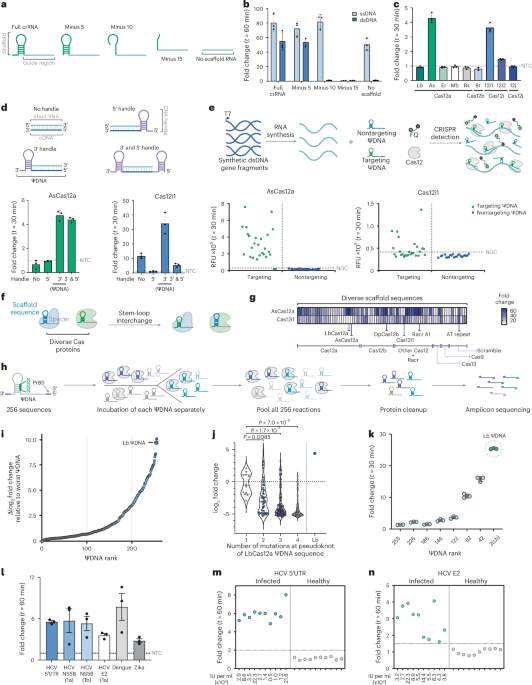
Fluorescence-based detection assays were performed in black 384-well plates. crRNA–Cas12 complexes were assembled in NEB buffer 2.1, incubated at room temperature for 10 min and then combined with FQ reporter (250–500 nM) and target activator in a total volume of 40 μl. Reactions were incubated at 37 °C and fluorescence was measured using a microplate reader (excitation: 483/20 nm, emission: 530/20 nm) at 2.5-min intervals. Unless otherwise indicated, final concentrations were 50 nM Cas enzyme, 100 nM crRNA or ΨDNA and 25 nM target.
For Michaelis–Menten analysis, AsCas12a–ΨDNA–RNA complexes were assembled as above and diluted to a final effective complex concentration of 1.25 nM (50 nM AsCas12a, 1.25 nM ΨDNA and 50 nM target RNA). Reactions were performed in NEB buffer 2.1 with increasing concentrations of FQ reporter (0.01–2 μM). Fluorescence was recorded at 37 °C using a real-time PCR system at 13-s intervals. A standard curve was generated using FAM reporter without quencher. Initial velocities (V0) were determined by linear regression and kinetic parameters were calculated using Prism10.
EMSA
EMSA gel was performed by mixing 100 nM of Cas12 protein (AsCas12a or Cas12i1), 100 nM guide (crRNA or ΨDNA) and 100 nM target (ssDNA or ssRNA) in NEB 2.1 buffer and incubating the reaction at 4 °C for 30 min. Then, 1 µl of 5× TBE Hi-Density sample buffer (Invitrogen, LC6678) was added to 9 µl of sample. The samples were loaded in a native PAGE DNA retardation gel (Invitrogen, EC6365BOX) and run at 200 V for 30 min. Later, PAGE gel was stained with SYBR gold (Invitrogen, S11494) and imaged on Amersham Typhoon.
Biolayer interferometry
Biolayer interferometry was performed on a GatorBio system using streptavidin biosensors (Flex SA Kit) and 3′-biotinylated DNA or RNA guides. Assays were conducted in NEB buffer 2.1 supplemented with 0.05% Triton X-100. Guides were immobilized at 50 nM onto streptavidin probes before measurement.
Association was measured by transferring loaded sensors into wells containing AsCas12a at concentrations of 1, 2.5, 5, 10, 25, 50 and 100 nM for 10 min. Dissociation was monitored by transferring sensors into buffer-only wells for an additional 10 min.
Data were analyzed using GatorBio software. Binding curves were fitted to a 1:1 binding model to determine association (kon) and dissociation (koff) rate constants. Equilibrium dissociation constants (Kd) were derived from steady-state analysis of concentration-dependent responses. Sensors without immobilized guides were used as negative controls.
Systematic ΨDNA evaluation assay
All ΨDNAs were synthesized by IDT. First, 50 nM AsCas12a,100 nM target RNA and 200 nM ΨDNA were incubated at 37 °C for 30 min; then, all ΨDNA groups were pooled together into a 15-ml tube and incubated at 37 °C for another 30 min. After incubation, pooled ΨDNAs were diluted 100-fold for amplicon library preparation. Q5 DNA polymerase was used for PCR. A library lacking AsCas12a was used as a control.
The amplicon libraries were sequenced by Illumina NextSeq 500 with a NextSeq 500/550 mid output kit v2.5 (150 cycles) (Illumina, 20024904). All computational work was performed on the University of Florida (UF) high-performance computing (HPC) cluster HiperGator.
IVT
IVT of long HIV and HCV RNA fragments was performed using a HiScribe T7 high-yield RNA synthesis kit (NEB, E2040S) following the manufacturer’s protocol and purified using the Monarch RNA cleanup kit (NEB, T2030L).
Endogenous mRNA detection
Total RNA from 1 × 10⁶ HEK293T cells (American Type Culture Collection (ATCC), CRL-3216) was extracted using the Monarch total RNA miniprep kit (NEB, T2010S). Then, cDNA was synthesized using the PhotoScript II first-strand cDNA synthesis kit (NEB, E6560) with Oligo-dT primers. Lastly, 17 endogenous genes were amplified using KOD One PCR master mix (Toyobo, KMM-201) and in vitro transcribed as described above. For detection, 2 µl of product was added to a CRISPR–Cas-based fluorescence detection assay.
Participant sample collection
The collection and processing of participant samples were approved by the UF Institutional Review Board (IRB202200294). For clinical validation, a total of 20 human serum samples were obtained from participants with HCV collected under the HCV-TARGET program, which also supplied the UI per ml of each sample reported in Fig. 4. Healthy serum samples were obtained from Boca Biolistics.
Participant sample extraction
Viral RNA was extracted from serum samples using the Quick-DNA/RNA viral MagBead kit (Zymo, R2140) according to the manufacturer’s instructions with minor modifications. Briefly, 200 µl of serum was treated with 10 µl of proteinase K (20 mg ml−1) for 15 min at room temperature, followed by the addition of DNA/RNA Shield (1:1, v/v). Samples were mixed with 800 µl of viral DNA/RNA buffer and 20 µl of MagBinding beads, vortexed for 10 min and separated using a magnetic rack.
Beads were washed sequentially with 250 µl of wash 1, 250 µl of wash 2 and two washes with 250 µl of 100% ethanol. After air-drying for 10 min, RNA was eluted in 30–60 µl of nuclease-free water and used for downstream analysis.
Participant sample validation
After extraction, samples were amplified by adding 1 µl of extracted viral RNA to a 50-µl SuperScript IV one-step RT–PCR reaction (Invitrogen, 12594025) and thermocycling was performed according to the manufacturer’s instructions. After amplification, 1 µl of product was added to a T7 and AsCas12a reaction master mix for RNA detection. This master mix contained 1× NEB 2.1 buffer, 62.5 nM AsCas12a, 112.5 nM ΨDNA (IDT), 500 nM FQ reporter (IDT), 1 mM rNTP mix (NEB, N0466), 2 U per ml of RNase inhibitor (NEB, M0314) and 12.5 U per ml of NxGen T7 RNA polymerase (Biosearch, 30221-1) in 20-µl reactions. Samples were then loaded into a 384-well plate, which was subsequently placed in a BioTek Synergy fluorescence microplate reader and incubated at 37 °C for 60 min. Fluorescence intensity readings for a FAM-labeled reporter were recorded at 483/20 nm (excitation) and 530/20 nm (emission) at 2.5-min intervals.
Amplicon sequencing for participant samples
Amplicon libraries were generated using SuperScript IV one-step RT–PCR followed by a second PCR with Q5 DNA polymerase to append Illumina barcodes. Libraries were pooled, gel-purified and sequenced on an Illumina MiSeqDx using a MiSeq Nano v2 kit. Sequencing reads were aligned to the HCV reference genome using Bowtie2 and SAMtools and visualized in JBrowse.
Mammalian cell culture
HEK293T (ATCC, CRL-3216), HeLa and MCF-7 cells were maintained in DMEM supplemented with 10% FBS and 1× penicillin–streptomycin at 37 °C with 5% CO2. HepG2 cells were cultured in RPMI-1640 supplemented with 10% FBS and 1× penicillin–streptomycin under the same conditions. HeLa, MCF-7 and HepG2 cell lines were obtained from M. Xie (UF).
Mammalian cell transfection
Plasmids were cotransfected with ΨDNAs into HEK293T cells using TransIT-X2. Cells were seeded at 5 × 10⁵ cells per ml 48 h before transfection. For reporter assays, 200 ng of mCherry, 350 ng of AsCas12a–GFP (or GFP control) and 400 ng of ΨDNA were transfected in 48-well plates; ΨDNA was replaced with randomized DNA in control samples. For endogenous RNA knockdown, we used 350 ng of AsCas12a–GFP and 650 ng of ΨDNA (targeting or nontargeting) or ΨDNA alone (650 ng) in transduced cells. ΨDNA input was reduced to 175 ng in HeLa, MCF-7 and HepG2 cells and multiplex ΨDNAs were combined to 650 ng total. Cells were harvested at 16–24 h after transfection.
For RIP–qPCR and MeRIP–qPCR, 2 × 10⁶ HEK293T cells were transfected with 1.33 µg of plasmid and 1.07 µg of ΨDNA using 6 µl of TransIT-X2. For RNase H1–AsCas12a experiments, transfection conditions were identical to the reporter assay.
Flow cytometry for quantification of mCherry expression
At 16 h after transfection, cells were trypsinized (1× trypsin–EDTA), resuspended in FluoroBrite DMEM supplemented with 10% FBS and filtered through a 35-µm cell strainer. Samples were analyzed on a CytoFLEX LX flow cytometer. Fluorescence data were processed using FlowJo (version 10.10) and the MFI of mCherry was quantified in GFP-positive cells.
Compensation was performed using single-color controls (GFP, mCherry) and BrightComp eBeads. The gating strategy is shown in Supplementary Fig. 4.
RT–qPCR for relative quantification of mCherry and endogenous mRNA
Total RNA of samples was extracted using Monarch Total RNA miniprep kit (NEB, T2010S) as per the manufacturer’s instructions. Extracted RNA was later added to the RT–qPCR mix TaqMan fast virus one-step master mix (Thermo, 4444434). The reaction was performed on an Applied Biosciences QuantStudio 5 real-time PCR system and multiplexed with FAM probes for mCherry and endogenous genes and a Cy5 probe for GAPDH as the housekeeping gene. mCherry primers and probes were designed using the PrimeQuest tool from IDT and GAPDH primers and probes were from Asahi-Ozaki et al.48. For endogenous genes (PPIA, RPL4, SMARCA4, NRAS and PCSK9), primers and probes were ordered from Thermo Fisher. The fold change was calculated relative to ΨNT using the ΔΔCt method.
mRNA-seq for off-target effect quantification
HEK293T cells were seeded at 5 × 10⁵ cells per well in six-well plates 48 h before transfection. Plasmids (1 µg; AsCas12a–GFP, RfxCas13d–GFP, dCas13d–GFP or GFP only) were cotransfected with 2 µg of ΨDNA using 8 µl of TransIT-X2 in 250 µL Opti-MEM. After 18 h, cells were trypsinized and resuspended in PBS supplemented with 2% FBS and GFP-positive cells were sorted using a FACSymphony S6.
Total RNA was extracted from sorted cells using the Monarch Total RNA miniprep kit (NEB) and RNA quality was assessed before library preparation. mRNA libraries were prepared using the NEBNext Ultra II directional RNA library prep kit in combination with the NEBNext poly(A) mRNA magnetic isolation module. Libraries were indexed using NEBNext multiplex oligos and validated for size distribution and concentration before sequencing.
Sequencing was performed on an Illumina NovaSeq X Plus (100 cycles) or NextSeq 500 (150 cycles), generating ~30 million paired-end reads per sample. Reads were aligned using HISAT2, processed with SAMtools and quantified with featureCounts. Differential expression analysis was performed using DESeq2, and visualization (for example, volcano plots) was carried out in R. All computational analyses were conducted on the UF HiPerGator HPC system.
Lentiviral cell line production of AsCas12a–GFP-expressing HEK293T cells
Lentivirus was produced in HEK293T cells seeded at 7 × 10⁶ cells per 10-cm dish in 12 ml of medium (50% DMEM with 10% FBS and 50% Opti-MEM) 24 h before transfection. For transfection, 41 µl of Lipofectamine 3000 and 35 µl of P3000 were mixed with psPAX2 (1.3 pmol), pMD2.G (0.72 pmol) and AsCas12a–GFP transfer plasmid (1.64 pmol) in Opti-MEM, incubated for 20 min and added dropwise to cells. Medium was replaced 6 h after transfection. Viral supernatant was collected at 24 h and 52 h, pooled, clarified by centrifugation, filtered (0.45 µm) and concentrated 10× using a Lenti-X concentrator (Takara).
For infection, reverse transduction was performed by adding 15–150 µl of concentrated virus to 5 × 10⁴ HEK293T cells per well in six-well plates in the presence of 10 µg ml−1 polybrene. After 72 h, cells were selected with 10 µg ml−1 blasticidin. Cells were passaged no more than three times before downstream RNA knockdown experiments.
RIP–qPCR
RIP was performed as described previously49. HEK293T cells transfected with HA–AsCas12a or HA–GFP and ΨPPIA were crosslinked with 1% paraformaldehyde for 15 min at room temperature and quenched with 125 mM glycine for 10 min. Cells were washed with cold PBS, harvested and lysed in buffer (150 mM NaCl, 10 mM Tris-HCl pH 7.6, 2 mM EDTA, 0.5% NP-40, 0.5 mM DTT and 400 U per ml RNase inhibitor) for 20 min on ice. Lysates were clarified by centrifugation (15,000g, 15 min, 4 °C) and 30 µl was reserved as input.
Protein G agarose beads (20 µl per sample) were incubated with anti-HA antibody (2 µl) in wash buffer (150 mM NaCl, 50 mM Tris-HCl pH 7.6, 2 mM EDTA, 0.05% NP-40, 0.5 mM DTT and 200 U per ml RNase inhibitor) for 2 h at 4 °C. Antibody-conjugated beads were then incubated with lysate overnight at 4 °C. Beads were washed three times with high-salt buffer (300 mM NaCl, 50 mM Tris-HCl pH 7.6, 2 mM EDTA, 0.05% NP-40, 0.5 mM DTT and 200 U per ml RNase inhibitor).
Bound complexes were eluted in SDS buffer (1% SDS, 10 mM EDTA and 50 mM Tris-HCl pH 7.4) and treated with proteinase K (1.2 mg ml−1) at 55 °C for 4 h. RNA was extracted using TRIzol, reverse-transcribed and quantified by RT–qPCR. Enrichment was calculated relative to input using the ΔΔCt method.
MeRIP–qPCR
MeRIP–qPCR was performed with modifications to a previously described protocol. Briefly, 5 µg of total RNA was fragmented in buffer (50 mM Tris-HCl pH 8.0 and 50 mM MgCl2) at 95 °C for 8 min and 10% was reserved as input. For IP, 30 µl of protein G beads were washed and incubated with anti-m6A antibody (3 µl) overnight at 4 °C in IP buffer (150 mM NaCl, 10 mM Tris-HCl pH 7.5 and 0.1% NP-40). Antibody-conjugated beads were then incubated with 4.5 µg of fragmented RNA in IP buffer supplemented with RNase inhibitor for 4 h at 4 °C.
Beads were washed five times with IP buffer and bound RNA was released by proteinase K digestion (5 µl) at 37 °C for 60 min followed by 56 °C for 15 min. RNA from input and IP samples was extracted using TRIzol, reverse-transcribed and quantified by qPCR using TaqMan assays. Enrichment was calculated relative to input using the ΔΔCt method.
Ribo-seq for ribosomal profiling
HEK293T cells were seeded at 5 × 10⁵ cells per well in six-well plates 48 h before transfection. Cells were transfected with 1 µg of AsCas12a–GFP and 2 µg ΨDNA using 8 µl of TransIT-X2 in 250 µl of Opti-MEM per well. After 15 h, cells were harvested, pooled in six wells per condition as one biological replicate (n = 2) and subjected to GFP sorting (~5 × 10⁶ GFP+ cells per sample).
Following sorting, 20% of cells were used for total RNA extraction and mRNA-seq library preparation as described above. The remaining 80% were used for ribosome profiling using the All-In-One RiboLace gel-free kit (IMMAGINA) as per the manufacturer’s instructions.
Sequencing was performed on an Illumina NovaSeq X Plus (1× 100 bp), generating ~300 million reads per sample. Reads were processed by bcl-convert and fastp, trimmed with cutadapt (minimum length: 29 nt) and unique molecular identifiers were extracted using UMI-tools. Ribosomal and transfer RNA reads were removed using Bowtie2 and the remaining reads were aligned to the hg38 genome using STAR.
Ribosome profiling quality control was performed using RiboWaltz with a P-site offset of 12 nt. Gene-level counts from mRNA-seq and Ribo-seq were obtained using featureCounts and differential translation efficiency was analyzed using RiboDiff. Results were visualized using R.
CLIP-seq
CLIP-seq was performed with minor modifications to a previously described protocol50,51. HEK293T cells stably expressing AsCas12a (1.5 × 10⁷ cells per sample) were labeled with 4-thiouridine (200 µM) and ultraviolet-crosslinked twice at 365 nm (150 mJ cm⁻2). Cells were lysed and partially digested with RNase T1 (0.2 U per µl). Clarified lysates were subjected to IP using Dynabeads protein G preconjugated with anti-AsCas12a antibody (10 µg of antibody per 100 µl of beads per 1 mg of lysate).
Following IP, complexes were washed and subjected to a second RNase T1 digestion (10 U per µl, 10 min, 22 °C), followed by high-salt washes. RNA–protein complexes were treated with proteinase K (37 °C, 15 min) and RNA was extracted by phenol–chloroform.
cDNA libraries were prepared using the NEBNext Ultra II directional RNA library prep kit and sequenced on an Illumina NovaSeq platform (2× 150 bp), generating ~50 million reads per sample.
Dual RNA–DNA editing with AsCas12a
HEK293T cells were seeded at 5 × 10⁵ cells per ml 48 h before transfection. Cells were transfected with 350 ng of AsCas12a–GFP or GFP-only plasmid and either 650 ng of ΨNT or a combination of 325 ng of ΨPPIA/RPL4 and 325 ng crCCR5 using 2 µL TransIT-X2 in 50 µl of Opti-MEM. Complexes were incubated for 25 min and added to 48-well plates.
At 18 h after transfection, cells were harvested, washed and divided into three fractions. One fraction was used for RNA extraction, one was used for immediate DNA extraction using QuickExtract solution (30 µl) and the third was reseeded for DNA extraction at 50 h after transfection. RNA was analyzed by qPCR and mRNA-seq and DNA was subjected to amplicon sequencing. Indels were quantified using CRISPResso2.
PLA
HEK293T cells were seeded at 5 × 10⁵ cells per ml in chamber slides (Lab-Tek) 48 h before transfection. Cells were transfected with 350 ng of AsCas12a–GFP or dRfxCas13d–GFP and 650 ng of ΨPPIA using 2 µl of TransIT-X2 in 50 µl of Opti-MEM. After 12 h, cells were washed with PBS and fixed with 4% paraformaldehyde for 10 min at room temperature, followed by permeabilization with 0.5% Triton X-100 for 10 min.
The PLA was performed using the Duolink in situ red kit according to the manufacturer’s instructions. Primary antibodies included anti-HA (for AsCas12a or dRfxCas13d) and anti-RNase H1, incubated overnight at 4 °C. Imaging was performed using a Leica fluorescence microscope.
Target design
Target sites were designed on the basis of RNA secondary structure and RBP-binding information. SHAPE reactivity scores from RASP version 2.0 were used to identify structurally accessible regions30,31,32 and RBP-binding sites were obtained from POSTAR3 to guide target selection33 from the available datasets.
Reporting summary
Further information on research design is available in the Nature Portfolio Reporting Summary linked to this article.