SUVs have completely taken over the American car market, and at this point, there’s one for just about every kind of driver. You can spend Bentley money on something ultra-luxurious, buy a rugged Toyota built for the trails, or grab a cheap compact crossover that still handles everyday life with ease.
But family SUVs are where things have really exploded lately, mostly because people want one vehicle that can handle everything without becoming a headache to own. The problem is that a lot of them are great at one thing and just okay at everything else.
That’s why the Honda Pilot stands out. It’s one of the few SUVs left that genuinely feels built to do a bit of everything well, whether you’re hauling kids, road-tripping, towing, or just trying to survive the daily school run.
In order to give you the most up-to-date and accurate information possible, the data used to compile this article was sourced from Honda and other authoritative sources, including the EPA, J.D. Power, Kelley Blue Book, and TopSpeed.

The Honda SUV That Has More Luxury Than A Lexus (And It’s Not An Acura)
This Honda SUV packs premium features, upscale design, and tech that rival a Lexus—proving luxury doesn’t always come with a premium badge.
How SUVs became the go-to vehicle for modern families
Why today’s SUVs had to evolve beyond just being tough workhorses

SUVs didn’t start out as the polished, family-friendly machines we see everywhere today. They were rugged, body-on-frame vehicles made for farms, job sites, and rough trails, not school runs.
Early icons like the Toyota Land Cruiser and Ford Bronco were basically truck cousins, built to tow, haul, and take a beating. Comfort and refinement weren’t really the point back then, and interiors were about as bare-bones as it gets.
It wasn’t until the late ’90s and early 2000s that automakers started to rethink what an SUV could actually be. Models like the Toyota Highlander and Honda CR-V kicked off the shift to car-based crossovers that were easier to live with day to day.

Instead of rough, truck-like rides, these new SUVs brought unibody construction, smoother handling, and cabins that actually felt comfortable. Suddenly, things like soft seating, better tech, and everyday practicality mattered just as much as toughness.
As city living became the norm, people started expecting a lot more from their vehicles. Safety tech, extra space, flexibility, and a more car-like feel all became must-haves instead of nice-to-haves.
That’s how we ended up with today’s family SUVs. You still get the occasional tough, rugged option, but most are built to handle everyday life first and everything else second.
What makes a “good” family SUV in 2026

The modern SUV market is so wide now that there’s no single “best” family SUV—it really comes down to how you live and what you need day to day. Some families want something rugged enough for weekend adventures, while still being comfortable and roomy enough for everyone.
If you do head off-road occasionally, something like the 2026 Land Rover Defender stands out, with proper trail capability, seating for up to eight, and a more upscale feel than you’d expect. On the other end, budget-friendly options like the 2026 Kia Sportage keep costs down at just under $29,000 while still offering up to 74.1 cubic feet of cargo space.
For buyers who just want something dependable and easy to live with, the Toyota Grand Highlander is a strong pick, with solid reliability scores and a focus on family practicality. And if you want something more compact, the 2026 Toyota RAV4 still delivers up to 70 cubic feet of storage in a more city-friendly size.

Forget everything else—this Japanese hybrid SUV just makes sense
Toyota’s 2026 RAV4 goes fully hybrid and doubles down on simple, smart, everyday practicality that just makes sense.
Why today’s family SUV has become the ultimate all-rounder
How one vehicle ended up replacing just about everything else in the driveway

Today’s family SUVs aren’t just people movers anymore—they’ve turned into all-rounders that can handle everything from the daily commute to long holiday road trips. Most are expected to juggle comfort, space, and capability without missing a beat.
Take something like the Toyota Grand Highlander, which can tow up to 5,000 pounds when you need it to. Or the Hyundai Palisade, which can seat up to eight people without feeling like a compromise on space.
Even efficiency has become part of the mix, with models like the Kia Sportage Hybrid returning up to 42 mpg in the city. With so much competition in the segment, SUVs now have to do a bit of everything just to stay relevant.
Space, safety, and tech now define today’s family SUVs

Older SUVs were all about toughness, and while that still matters, today’s family models are judged more on space, comfort, and tech. It’s less about surviving rough terrain and more about surviving school runs, road trips, and everything in between.
Big three-row SUVs like the Chevy Suburban and Ford Expedition still lead the way for maximum space, while even two-row full-size models like the BMW iX offer up to 78 cubic feet of cargo room. On the smaller end, something like the 2026 Mazda CX-5 still manages generous space too, with solid legroom front and rear.
Tech has become just as important as size, with big infotainment screens, wireless phone connectivity, USB ports, and driver assistance features now expected across the board. Safety systems are just as decisive, and for most families, they’re often the feature that seals the deal.
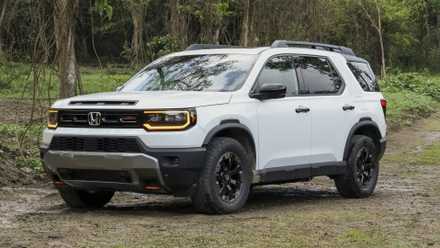
How the 2026 Honda Passport quietly beats more expensive rivals
The 2026 Honda Passport brings 285 horsepower, upgraded AWD, and rugged looks to take on off-road rivals like the Bronco and Land Cruiser.
The 2026 Honda Pilot is the family SUV everyone else is measured against
Why it quietly became the go-to standard for space, comfort, and daily practicality
The 2026 Honda Pilot is the third year of the fourth-generation model, continuing a nameplate that’s been around since it first launched in the U.S. back in 2003. It’s always been aimed at families, and that same practical DNA is still there—just updated for how people actually drive today.
For 2026, there are seven trims to choose from, starting at $42,195. The lineup includes the Pilot Sport, EX-L, TrailSport, Touring, Touring Blackout, Elite, and Black Edition.
Comfort, reliability, and space without the luxury price tag

$42,000 might sound like a big step-up, but the Pilot backs it up with strong equipment levels and Honda’s long-standing reputation for durability. Here’s how the 2026 lineup breaks down by starting price.
|
2026 Pilot Sport |
2026 Pilot EX-L |
2026 Pilot TrailSport |
2026 Pilot Touring |
2026 Pilot Touring Blackout |
2026 Pilot Elite |
2026 Pilot Black Edition |
|
|---|---|---|---|---|---|---|---|
|
MSRP |
$42,195 |
$44,495 |
$50,395 |
$51,095 |
$52,295 |
$53,495 |
$54,995 |
The 2026 Pilot scores well in recent J.D. Power ratings, with an overall 83 out of 100, an 82 for driving experience, and 81 for reliability. It also earns a solid 3.5 out of 5 from RepairPal, which is considered above average, and comes in cheaper to maintain than the average vehicle at around $542 a year.
Inside, it’s all about usable family space. You get 22.4 cubic feet behind the third row, 60.1 cubic feet behind the second, and a huge 113.7 cubic feet with everything folded flat. There’s room for everyone across all three rows, though the back seats are best suited for kids rather than adults on longer trips.
|
First row |
Second row |
Third row |
|
|---|---|---|---|
|
Headroom |
40.5 inches |
40.2 inches |
39.3 inches |
|
Shoulder room |
61.9 inches |
61.7 inches |
59.5 inches |
|
Hip room |
58.4 inches |
57.4 inches |
44.6 inches |
|
Legroom |
41.0 inches |
40.8 inches |
32.5 inches |
The Pilot makes its case through its interior more than anything flashy. Even the base trims feel solid and well put together, and Honda clearly built it with long-term use in mind rather than gimmicks.
Every version comes with a 12.3-inch infotainment screen running HondaLink, while the base Sport keeps things simple with tri-zone climate control and physical buttons that are easy to live with. Step up to the EX-L and you get leather seats, wireless Apple CarPlay and Android Auto, plus one-touch access to the second row.
Move into the Touring and things get more premium with a panoramic sunroof, surround-view camera, hands-free tailgate, and a Bose sound system. At the top end, the Elite and Black Edition add a head-up display, extra interior detailing, USB ports across all three rows, and clever storage touches, including a removable second-row center seat in some trims.

Does your next SUV have enough cargo space? 3 things the specs don’t tell you
Cubic feet measurements don’t tell the whole story.
The Honda Pilot leads the 2026 family SUV pack
Why it’s the one to beat for space, comfort, and everyday practicality
The Honda Pilot is often called a midsize SUV, measuring 200.1 inches long and 78.5 inches wide, though Honda itself slots it in as a full-size model. It’s a bit bigger than some rivals, but that extra size pays off in how well it balances space, comfort, and everyday usability.
There’s just one engine on offer for 2026, and unlike many competitors moving away from it, the Pilot still sticks with a V-6. It gives the SUV a more traditional, smooth character that feels a little old-school in the best way.


- Base Trim Engine
-
3.5-liter V6
- Base Trim Transmission
-
10-speed automatic
- Base Trim Drivetrain
-
Front-Wheel Drive
- Base Trim Horsepower
-
285 hp
- Base Trim Torque
-
262 b-ft
- Make
-
Honda
- Model
-
Pilot
- Segment
-
Midsize SUV
Front-wheel drive comes standard on the Pilot, with all-wheel drive available across the range if you want extra traction. It can also tow up to 5,000 pounds, so a small boat or weekend trailer isn’t a problem, especially with its smooth V6 doing the work.
Fuel economy is fairly reasonable for a vehicle this size. According to the EPA, the FWD model returns up to 22 mpg combined, while AWD versions sit around 21 mpg, with the TrailSport dipping slightly to 20 mpg. Annual fuel costs typically land somewhere between $2,700 and $3,000 depending on the setup and driving style.
The Pilot as the most well-rounded choice in its class

Where the Pilot really stands out this year is how easily it adapts to different parts of daily life. It can tow, haul plenty of gear, look and feel well-finished inside, and even handle light off-road duties when you need it to.
The TrailSport trim is the most capable version for that kind of use, adding off-road-tuned suspension, 8.3 inches of ground clearance, skid plates, and recovery points. You also get all-terrain tires, approach and departure angles of 19.9 and 19 degrees, plus a TrailWatch camera system that helps when the trail gets tricky.
The key thing is that none of this makes it worse to live with day to day. Honda’s i-VTM4 AWD system can send power to individual rear wheels for better traction and stability, while seven drive modes—including Sand and Trail—let you tweak how it behaves. With a payload capacity of around 1,100 to 1,500 pounds, it still works just as well for the school run and weekly errands as it does for weekend trips.
How the Hyundai Palisade and Toyota Grand Highlander compare against the Pilot

This year, the Hyundai Palisade and Toyota Grand Highlander are the Pilot’s closest competition in the three-row space. The Palisade undercuts it slightly on price at $39,435 and can return up to 25 mpg combined, but it offers less overall cargo space at 86.7 cubic feet with the seats folded.
The Grand Highlander sits closer to the Pilot at $41,860 and brings a hybrid option that can achieve up to 36 mpg combined, along with generous third-row space and up to 97.5 cubic feet of cargo capacity. Even so, it still falls short of the Pilot’s total space, and it doesn’t really offer an off-road-focused trim like Honda’s TrailSport.

10 Great Three-Row SUVs You Can Buy for Under $40,000
Value, comfort, and versatility for families alike—these spacious three-row SUVs for under $40,000 tick all the boxes.
The Honda Pilot sets the tone for family SUVs in 2026
Why it quietly became the benchmark for balance, practicality, and everyday ease

There’s no doubt the Palisade and Grand Highlander are strong three-row SUVs in their own right. But where many rivals lean hard into one strength or another, the 2026 Pilot takes a more balanced approach and just quietly gets on with doing everything well.
It doesn’t chase luxury flash or try to be a hardcore off-roader. Instead, it sticks to what most families actually need day to day—steady power, a capable AWD system, loads of usable space, and a reputation for durability that doesn’t feel over hyped.
In many ways, the Pilot shows where the segment is heading. Buyers don’t want to compromise between comfort, practicality, and capability anymore, and Honda has clearly leaned into that shift. It lands right in the middle of all three, making it one of the most complete “one SUV does it all” options on the market today.